


How Can SpectraCell Testing Help You?
September 20, 2016
5 Ways to Treat Your Facet Joint Syndrome
October 4, 2016
While foot pain causes can be traced back to may different sources, don’t rule out a Morton’s Neuroma. Do you suffer from tingling, toe cramping, or sharp and shooting foot pain that seems to only being getting worse? Morton’s Neuroma is an irregular thickening of the nerve tissue between your third and fourth toes. While the exact cause for the condition is not known there are groups and patterns that seem to fall victim to this condition more than others. Treating this condition does NOT have to be done invasively or with surgery. Discover the natural, drug-free alternatives our clinic can offer you.
What is a Morton’s Neuroma?
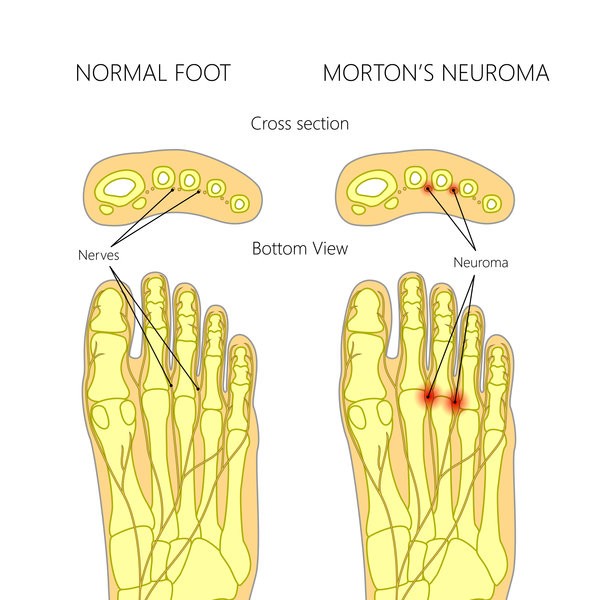 Simply put, a neuroma is a swollen nerve. Commonly, a Morton’s Neuroma will manifest with pain, numbness, burning, or tingling at the base of the toes on the bottom of the foot–often, between the third and fourth toes. The symptoms arise from a nerve regularly being irritated or pinched causing extra fibrous tissue to form.
Lifestyle Changes for Treating Your Morton’s Neuroma
Making changes to your current lifestyle that are exacerbating your Morton’s Neuroma symptoms and pain is the first advised natural-care approach. Your inflamed nerves need time to heal. The first thing to consider is your activities. If you are involved in many high-impact sports or activities that don’t allow your foot to rest, eliminate them–if possible–for the time being. If you are a runner, try cycling or swimming. Elevate your foot as much as you can. Beyond resting your foot, examine your shoes. You may need to look for a shoe with a wider toe box. The Podiatry Institute recommends using metatarsal cushion pads or inserts to better support your arch, give space between your toes, and reduce pressure on your pinched nerve. Incorporating these seemingly small changes can yield amazingly positive results.
Anti-Inflammatory Injections for Pain Management
Another form of natural treatment for your Morton’s Neuroma are anti-inflammatory injections. Steroid injections numb nerves without making permanent changes to your foot’s structure. Anesthetic shots can relieve nerves that keep sending out signals of pain due to nerve compression. Since steroid chemicals relieve inflammation in general, they also help reduce swelling in addition to pain. The needle is used to penetrate into the area around the affected nerve so the medications are delivered right where they are needed.
Massage Therapy for Morton’s Neuroma to Relieve Pressure
Massage therapy relieves pressure put on your nerves from tight muscles and tendons. When it comes to nerve compression in your foot, massage can help stimulate blood flow and nerve function while working to reduce your chronic pain. Something to note about massage therapy for this condition, not all techniques are appropriate for treatment. Some techniques can actually aggravate the condition and promote dysfunction. Deep pressure massage between the metatarsal heads should be avoided. Spreading or mobilizing the metatarsal heads with careful, appropriate pressure can help reduce the effects of nerve compression. By working with one of our Texas Spine and Sports Therapy Center’s trained providers, you can ensure that we will only incorporate safe methods of massage for your care.
Orthopedic Shoe Inserts to Better Support Your Foot
In some cases of Morton’s Neuroma, it is helpful to incorporate orthotic supports to help relieve nerve compression. You should also consider avoided shoes with heels or that confine/compress your toes and related soft tissues. Seek out supports that work to keep your feet in proper alignment during activity and treatment. Shoes make a huge difference in the health of your feet. Our Austin team can help you find shoes that will work best for your needs and specific foot pain issues.
Call for a Morton’s Neuroma Consultation
Selecting a state-of-the-art facility to treat your Morton’s Neuroma symptoms and pain can help guarantee your success. After a thorough evaluation in our clinic, we can determine which treatment options, or which combination of treatment options, will work best for your symptoms. Texas Spine & Sports Therapy Center provides you with the team approach you need to get to your desired goals safely and efficiently. Conveniently Located Near Seton Hospital on 38th Street in Austin, Texas, our team of multidisciplinary providers are trained and skilled at providing you the pain relief you seek. Call us at (512) 806-0015 today to make an appointment.